The Path to Tai Chi
My tai chi journey started about four years before my major medical event. Tai chi was initially a way to stay at least peripherally connected with my martial arts background as I aged. Tai chi classes then became a big part of my recovery from sudden onset paralysis due to a brain mass. Skills learned during tai chi classes helped in every phase of physical therapy. Balance and being aware of my center was a huge benefit. Even being able to flow chi (energy) into the paralyzed left side helped too.
Medical Crisis
One morning in late October 2012, I could not get up out of bed after three attempts. My wife had to help me get sweatpants on for a quick trip to the ER, where I soon collapsed on their floor.
The Diagnosis
Sometime later after a head CT, the doctor came in and said, “Earl, the good news is that you did not have a stroke. The bad news is that we found a 2-centimeter tumor in your right frontal lobe, which likely explains why you cannot now move the entire left side of your body.” People generally don’t survive brain tumors for very long, so this was scary news.
The neurosurgeon removed the tumor easily three days later after my vital signs stabilized (blood pressure, body temperature, and blood sugars varied wildly every hour, and it was not at all clear at first that I would survive to get the surgery). The mass they removed wasn’t cancerous, thankfully. It was a weird infectious mass; essentially my brain had a big zit. But it did paralyze the whole left side of my body for a long nine days. I was left wondering if I would ever play guitar, or walk, work, go to the bathroom without help ever again at age 53. Would my life consist of staring at the ceiling from a hospital bed or being in a wheelchair?
The Road to Recovery
The doctors initially had no explanation for why I was paralyzed. Eventually, they figured out that an infection caused swelling around the mass and the swelling affected the motor control center of my brain. Some heavy-duty IV antibiotics began to reduce the swelling over a few days, and I slowly regained some functions. To this day no one can tell me what caused it, how long it might have been there, or how quickly it had grown. All we know after the fact is which type of bacteria was involved (very common but rarely seen in the brain) and the symptoms that suddenly occurred. The fairly young neurosurgeon said it was unlikely that he would ever encounter another case like mine in his career.
I spent a month in the rehabilitation hospital with stroke patients, many that had very grim prognoses—motorized wheelchairs, unable to speak or feed themselves, etc. Meanwhile, I was slowly improving and began experiencing survivor’s guilt. The last day before leaving rehab, at the insistence of one of my physical therapists, I was able to strum my ukulele and sing a few simple songs for a ten-minute pre-dinner performance for my fellow patients, helped by my wife playing the flute. We were all in tears, including the nurses. One fellow I had befriended at meals wheeled up afterward, crying. “I have played the clarinet all my life, and never will again. Thank you for performing for us.”
Music and other basic rehab took the better part of a year. At first, the challenge was learning to walk with a walker, get up out of bed safely, and perform other essential life skills. After regaining some hand function, I started strumming my ukulele while still in the hospital, gradually re-learning chord shapes again, then fingerpicking. Eventually, when my left hand got strong enough, I moved to a nylon string guitar, and when I could play that reasonably well for 30 minutes, I switched over to steel-string guitar for a few minutes at a time. Five years later there are still lingering balance issues in the dark. My left leg has only revered about 80% of its former strength, and my left ankle is permanently weak and numb. I can play fingerstyle guitar at about 95% of the pre-event skill level, although barre chords are somewhat more of a challenge than they were before.
Healing with Tai Chi
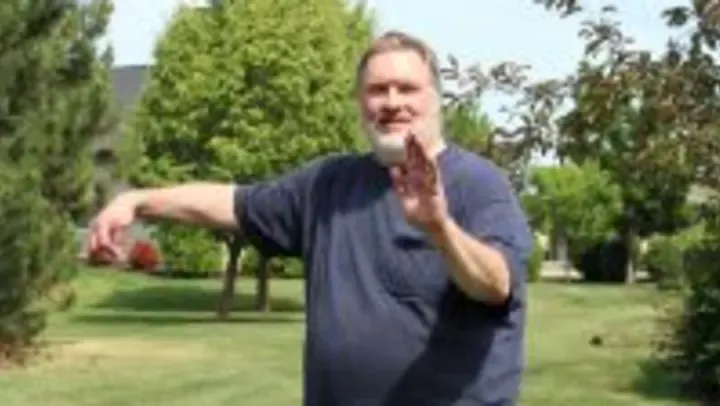
The gentle slow-moving art of tai chi was a wonderful discovery when I had to stop practicing and teaching karate because my joints had simply taken too much of a beating over the years. It became even more important to me after my brain tumor. Tai chi is relaxing and focuses on balance and body awareness. It is of significant health benefit to anyone suffering from mobility or balance issues, and can even be learned and practiced while seated.
- By shifting weight from one leg to the other and stepping, movement forces both sides of the body to work.
- Simply learning the form also helps with memory.
- The standard 108-move Yang style “long form” comes in three sections, lasting five minutes, eight minutes, and finally ten minutes.
All the basic elements and principles are covered in the first section, with the other sections adding more “vocabulary” or variations on the movements. While tai chi is fundamentally a martial art, it can be practiced by anyone and is not at all aggressive. The best description is “a moving meditation.” An hour of tai chi class melts away the stress of the day.